
By Kevin Sears
Before the next chapter of my life begins as I graduate, let’s revisit the pages I turned this year. Below, I created a tier list of some of the most memorable books I read throughout high school ranked based on my enjoyment and the impact they had on my life.
Just to set the record straight, this isn’t some deep dive into the literary genius or cultural influence of these books because one, I probably would’ve ranked Voltaire’s ‘Candide’ higher if I could’ve caught all the satire and highbrow humor that flew right over my head and two, you’re probably not reading a high school newspaper for literary merit—we have our favorite class AP English Literature and Composition for that.
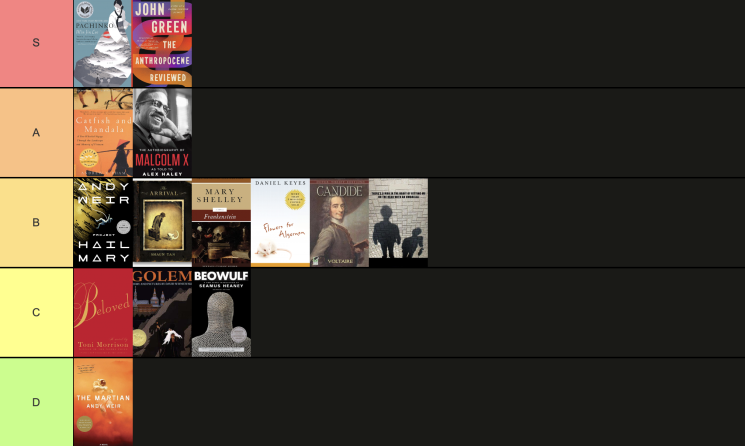
High school has effectively eaten up my time (like I’m sure it has done to yours). Fortunately, I spent my summers—instead of volunteering to boost my college application—reading. One of my most extraordinary memories is crying while flipping through the first chapters of ‘Pachinko’ by Min Jin Lee on a plane to Chicago during my sophomore year.
Both a fictional and true story, ‘Pachinko’ by Min Jin Lee is my favorite book of all time not only for its emotional impact but also for its relevance. Following four generations of a poor, yet proud Korean immigrant family in Japan, the main character of ‘Pachinko’ changes going down the lineage. Each new story battles newer, and more abstract challenges from systemic poverty to racism.
To me, two stories were going on. The first was a historical-political commentary on the cultural relationship between Japan and Korea from the early 1900s onwards about events such as the Japanese occupation of Korea and the splitting of Korea into two countries. The other story is about the family, following their personal journey enduring challenges towards their family, identity and desires in the midst of these worldly dramas.
This book topped my chart for its depth and the breadth of each character. Without a singular main character, I never got bored following one personality, but by no means did this undermine the amount of detail and care that went into creating each person’s identity.
If you ever find yourself with this book in hand, clear your schedule and find a comfortable place to rest, because it will be a long journey.
Originally, I planned to write a review of every book I read, but, after realizing how long it took me to write about Pachinko, I’m discovering that I’m lazy. I’ll write a review for just the S-tier books because I have some strong opinions about them.
‘The Anthropocene Reviewed: Essays on a Human-Centered Planet’ by John Green.
Another writer already wrote a review of ‘The Anthropocene Reviewed,’ so I won’t spend too much time summarizing the plot, but you should definitely check out hers here.
I’ll start by saying that this book was my guilty pleasure during college application season.
A collection of essays on the contradictions of the human experience, you’ll find yourself reading about heartbreak, your notes app and death, all strung together into an overlying theme of hope.
In each chapter, Green somehow manages to transform the mundane into poetry, to turn the invisible parts of our modern society into what it means to be alive. Every chapter is independent of each other, so you could jump around a bit.
My favorite chapter has to be ‘Googling Strangers.’ I won’t summarize ‘Googling Strangers’ much because I think you have to read it, but this chapter broke my heart, and I think it’ll do the same to yours.
Taking place at a children’s hospital, I don’t think there’s a place filled with more contradictions than a hospital. It holds more prayers than a church, yet more death and loss than a cemetery. Babies are born there, the elderly pass away and I visit for my yearly checkup. Some leave cancer-free, while others hear their first diagnosis. ‘Googling Strangers’ is about Green’s experience as a twenty-two-year-old student chaplain assisting patients and parents alike.
I’m sure working at a hospital, Green was familiar with many of these contradictions, and yet, in such a harrowing place, Green chose to write about hope. It’s always hard to put hope into words, especially as a high school student with college decisions at my doorstep, where I’m filled with hope, and hopefully not disappointment, but this book helped me identify hope where I couldn’t see it before.
If that made any sense to you and sparked your interest, I beg of you, please pick up this book.