
By Andrew Georgy
“Duke has to win! They’ve got Cooper Flagg, the predicted number one NBA Draft Pick!”
“No way, Dylan Harper is way better! Rutger to the top!”
Since the beginning of March and even into April, the only talk in the college basketball community was about March Madness, and with good cause. The NCAA Division I men’s basketball tournament, also known as March Madness, is the biggest college basketball event annually, with this year’s final scoring over 18.1 million viewers alone.
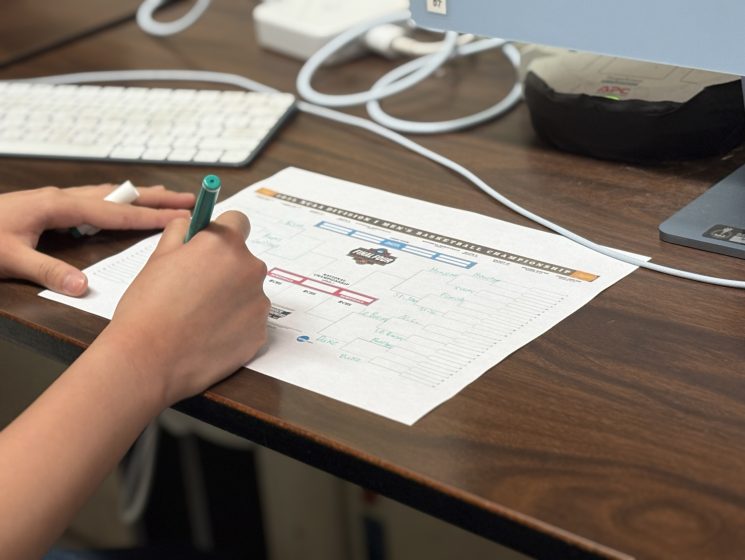
The tournament’s popularity and uncanny tendencies for upsets made it one of the most closely predicted in sports, with everyone ranging from ESPN analysts to high school students vying to predict the winner and even the entire bracket. Yet despite everyone’s efforts, is it even possible to correctly forecast with 100% accuracy?
The short answer: no. Although the average viewer will tell you that it’s totally feasible with enough watching and monitoring, the real odds are impeccably slim, reaching 1 in 9.2 quintillion (for comparison, 9.2 quintillion seconds is equivalent to 292 billion years). Even if you use team strength and records as a factor, the odds only become closer to one in 120 billion.
Predicting the scores for 68 teams and 67 matches is nearly impossible when one mistake can ruin the entirety of your bracket.
For example, using this year’s tournament as an example, the No. 10 seed Arkansas defeated the No. 2 seed St. John’s in the second round despite some predictions putting St. John’s in the final eight. UConn Huskies, who won back-to-back championships the previous two years, were knocked out by the Florida Gators, who hadn’t won a championship since 2007. Even Duke, who had one of the best offensive ratings (and the best player) in the entire league, struggled and fell to the Houston Cougars in the final minute despite being up fourteen points with 8:17 left on the clock.
Even in our own March Madness tournament held here at school, you most likely couldn’t predict the winner because of certain turnarounds or unlucky plays. One team may dominate shooting threes in one round and then struggle to make a single one in another.
If you’ve watched March Madness for a few years now, you also know it’s not just about each team’s player strength. Instead, team coordination, effort, tactics, injuries, coaches and sometimes just pure luck play a much more substantial role in deciding closely knit games, especially in the later stages.
In fact, the closest person to ever come close to achieving a perfect March Madness bracket was Gregg Nigl, a neuropsychologist in Columbus, Ohio. He had 49 correct picks before falling in the Sweet 16 round. The second closest, Yahoo Sports, had a 39-game streak achieved in 2017.
Whether it’s debating about the best players or simply enjoying the games, try to enjoy March Madness without bragging about how good your bracket is next time.