By Leroy Tran
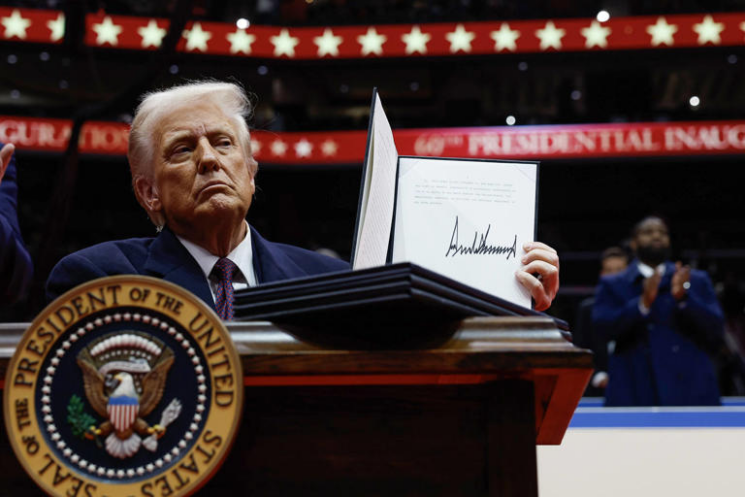
It has been over a year since Donald Trump was inaugurated.
When the election came 452 days ago, the results were not surprising. For a time before the election, there was a brief glint in the Democratic Party’s window—Kamala Harris seemed to be effectively leveraging social media to earn young people’s votes. Yet, Trump won among young men and ultimately secured the popular and electoral vote.
It was not unexpected, because Trump’s platform aligned with the trends in right-wing ideology that are epidemic among the younger generation; he promised isolation from foreign affairs, deportation of immigrants, tax reductions supported by tarrifs and improvements to government efficiency. But the ways in which he has gone about appeasing his voter base and fulfilling campaign promises have been detrimental to the condition of democracy. Although we have entered 2026, with Project 2025 having quietly exited the public consciousness, the vestiges of its authoritarian interests continued to make appearances in Trump’s decisions throughout last year. It is evident that constitutionality is the biggest question for this administration.
But if we disregard the questionable constitutionality of Trump’s past year, has his agenda been successful? Despite overwhelming criticism, it is important to acknowledge the administration’s successes. However, it doesn’t seem to have succeeded; let’s take a look.
ECONOMIC AND INTERNAL REFORM
These two go hand in hand, particularly after the passage of the One Big Beautiful Bill Act (OBBBA), the pièce de résistance of Trump’s economic policy thus far.
His economic promises prior to election were far-fetched, based on a platform of sweeping tariffs that would institute an elimination of the federal income tax, despite expert criticism—according to experts, this plan would be economically infeasible. Moreover, the Trump administration’s unilateral tariff policy is dubiously legal at the least, raising concerns among even his conservative allies in the Supreme Court.
Tariffs have yet to demonstrate the economic viability that Trump assured, far from returning to a Gilded Age economy with no income tax. They make up only a fraction of federal revenue, whereas taxes still make up over half. The grand tariff policy that promised to subsume the ills of taxation on the American people is nowhere to be seen; in reality, Trump has, through the OBBBA, supported the widening of wealth inequality by giving tax breaks to the wealthiest Americans at the expense of the income of the lowest 30% of the population.
Trump also promised to reduce inefficiency in the federal government and cut federal spending by slashing the budgets of federal agencies and firing employees, and yet the trends of federal spending and the national debt indicate that the administration and its Department of Government Efficiency (DOGE) have not accomplished its goals in this regard. Rather, DOGE has cost the government billions in wasteful spending and revenue loss, all while Trump and his OBBBA have sought to deprive Americans of necessary aid programs like Medicaid and SNAP.
These failures to improve the economy and the federal government are indictments of Trump’s campaign promises. It seems that nowhere in economic policy has he truly succeeded, as reflected in the growing weariness of the American people for the economic year ahead, with prices rising and affordability becoming a bigger question.
IMMIGRATION REFORM
One promise that Trump has purportedly fulfilled is his crackdown on illegal immigration; he has deported more illegal immigrants in 2025 than in the four years under Joe Biden. There is a discrepancy, of course—these numbers come with extensive infringements on the rights of foreign-born individuals, billions of dollars in spending and growing resentment toward the United States Immigration and Customs Enforcement (ICE).
In March, Kilmar Abrego Garcia, an El Salvadorian man living in Maryland, was wrongfully deported to El Salvador and incarcerated in the Terrorism Confinement Center (CECOT), despite court orders that explicitly prevented his deportation to the country. Presently, after a long legal battle between the Trump administration and the Supreme Court, Abrego Garcia has been brought back to the United States to face charges of migrant smuggling. But the details of the story should not distract from the fact that Trump wrongfully deported a man to be incarcerated in a prison that has been condemned for torture and human rights violations.
Furthermore, the Trump administration continues to challenge the boundaries of its executive powers regarding immigration policy, going so far as to consider suspending detained immigrants’ habeas corpus, the right of an individual to challenge their confinement that is protected by the Constitution’s Suspension Clause. To even question suspending habeas corpus clearly demonstrates Trump’s willingness to challenge and violate the Constitution over last year.
Trump has poured billions of dollars into funding his administration’s frankly unconstitutional immigration policy, as seen in the OBBBA: over $100 billion was directed to ICE in the bill—the same bill that will leave 16 million people without insurance from cuts to Medicaid. In this way, Trump has reneged on his economic promises to fulfill his immigration ones; more people will be deported from this country at the detriment of the American people.
That $100 billion has gone to an organization that does not have the interests of the American people at heart. Instead of “[prioritizing] removing the worst of the worst criminal illegal aliens,” and strengthening national security, ICE has been motivated by quotas to arrest hardworking men and women who pose no threat to the United States, which we have often seen in our community. In Orange County, reports of regular people from all walks of life being detained and abused by ICE are now ordinary. Trump’s ICE is tearing apart families and communities, and let us not forget the killing of Renee Nicole Good and Alex Pretti this month. An agency that promises to protect the safety of its citizens has instead enacted terror upon them. ICE agents have rarely been held accountable, while Trump and his administration praise their work and defend their worst actors.
FOREIGN POLICY
In October, the Sharm El-Sheikh Peace Summit produced the Trump Declaration for Enduring Peace and Prosperity, a plan to end the war in Gaza between Israel and Palestine. Trump campaigned on a platform of peace and isolation during the election, and he has been applauded for arbitrating in some foreign conflicts. However, many of his promises for peace, such as the end of the Russia-Ukraine War, remain unfulfilled.
It goes without saying that a president whose administration has renamed the Department of Defense to the Department of War is not interested in peace, and the past year has shown that Trump is willing to intervene in other countries with force.
Earlier this month, the U.S. military, without a formal declaration of war from Congress, struck Venezuela and captured its president, Nicolás Maduro. Prior, Secretary of War Pete Hegseth authorized strikes against suspected Venezuelan drug-smuggling boats in Caribbean waters, drawing scrutiny from the legal community. Now, the capture of Maduro has heightened concerns regarding the President’s powers. Is this an act of war? If so, why is the president who campaigned on peace going to such lengths? Is this even constitutional?
Trump is no stranger to war, and certainly no agent of peace. Earlier this year, his administration supported Israel in striking Iranian nuclear sites. The Trump administration has supported and funded Israel throughout its first year, a controversial alliance for the peaceful President, as Israel has been cited as committing genocide in Palestine. Trump is arguably abetting genocide, despite participating in the peace summit for Gaza; Israel has no interest in peace in Gaza, evidenced by their refusal to appear at the summit. As an ally of the Israeli government, Trump has no interest in peace.
WHAT NOW?
The Trump campaign was largely deceptive. In his first year, the promises made to the American people, purportedly in their interest, have been left unfulfilled or fulfilled in such a way that betrays Americans.
Trump still has another 3 years in office. As we look toward an uncertain future for the United States, we should have two hopes: ideally, we look upon this administration and make use of the ability to vote to affect real change in the government, or this administration may, through some means of change, take shape to actually benefit the American people.
The midterm elections are this year. If you are like me and can vote this year, and you feel scorned by this government as I have, I urge you to go out and vote. Let there be a future better for all of us.