By Kailyn Huynh
When the noise of hateful rhetoric and exploitation oppress the cries of our nation, silence should never be what follows. Now, more than ever, we must carry ourselves at full volume. We must express our pride and most authentic selves. The Grammy’s, Super Bowl and Bad Bunny are showing us exactly how — through the sound that penetrates in every open ear and the language that transcends racial and social barriers — through music.
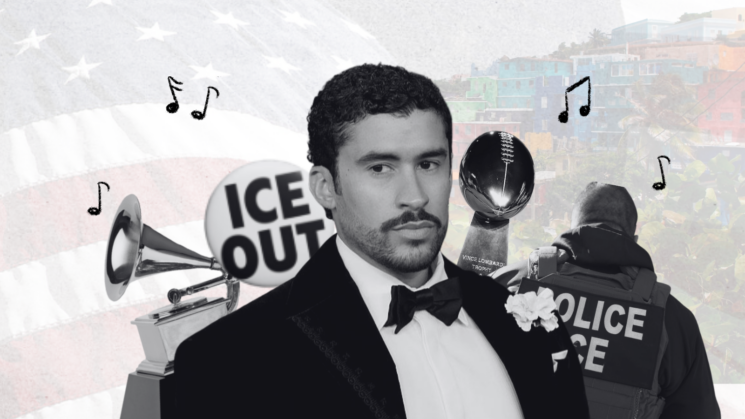
Artists and guests at this year’s Grammy Awards expressed a clear message. With “ICE OUT” pins adorning the outfits of the Grammy’s red carpet, attendees publicly protested the overwhelming presence of United States Immigrations and Customs Enforcement (ICE) in local communities.
Anti-ICE protests initially gathered speed in early July when the Trump administration signed into law the “One Big Beautiful Bill Act”, which expanded ICE’s budget to $85 billion dollars over the course of four years. Subsequently, the agency’s overreach and inhumane, even unconstitutional, enforcement actions have sparked massive backlash among American audiences. Tensions between activist groups and ICE peaked after the recent deaths of US citizens Renee Nicole Good and Alex Jeffrey Pretti, who were fatally shot by ICE agents in Minneapolis, Minnesota the previous month.
Before the Grammy’s, anti-ICE advocacy first made its way onto the floors of the Golden Globes. Celebrities who walked the red carpet gave the media their first look at “ICE OUT” and “Be Good” pins. However, these statement pieces felt more subtle and decorative than their intended impact, as they lacked any direct commentary to follow up. Grammy’s attendees, on the other hand, played their tune loud and clear.
While activism has always made appearances at the Grammy Awards, this time was notably different. For these artists, the topic of immigration and attitudes surrounding it was an issue they felt deeply personal about — something they weren’t afraid to openly express. Olivia Dean, British singer-songwriter and recipient of the Best New Artist award, emphasized her identity as the granddaughter of an immigrant.
“I’m a product of bravery and I believe those people deserve to be celebrated,” Dean said. “We’re nothing without each other.”
Dean’s statements of unity are vital in today’s world, where talks of immigration are extremely polarizing. In both America and countries throughout the world, immigrants and non-immigrants alike rely on one another. While we may coin ourselves the “Home of the Brave”, Dean’s words offer us the chance to reflect and redefine what bravery truly is, and what it means to be American.
Puerto Rican artist Bad Bunny echoed this idea of the American identity in his speech for Best Música Urbana Album.
“We’re not savage. We’re not animals. We’re not aliens. We are humans. And we are Americans,” Bad Bunny said.
Beyond any status of citizenship, Bad Bunny reminds us that, on this land of immigrants, we should all be treated with the same dignity. This is the American soil of opportunity that we all aspire to reach, and it is not a place designed for resentment.
Bad Bunny, who will take center stage at the half time show during this year’s NFL Super Bowl, is no stranger to hostile and discriminatory treatment. Due to his Puerto Rican identity, he has many times been incorrectly labeled as non-citizen, despite living in an American territory. Furthermore, the traction he has gained as a Latino performer and headliner has caused dissenters to label him as “anti-American” and “radical”, especially because he predominantly sings in the Spanish language.
Even so, Bad Bunny refuses to let this bitterness and antagonism stop him from representing his authentic Puerto Rican American self. On one of the most televised broadcasts in the United States, he will be singing to DeBÍ TiRAR MáS FOToS, the fully-Spanish album which won him both Best Música Urbana Album and the Grammy’s top honor, Album of the Year.
“We need to be different,” Bad Bunny said. “The only thing more powerful than hate is love. If we fight, we have to do it with love.”
Although it may seem “anti-American” to some, Bad Bunny’s presence as Latino artist who isn’t afraid to be upfront with his political beliefs of “ICE out”, who proudly speaks and sings his native language in front of a global audience and, most importantly, carries a value of compassion, is exactly what America needs today.
Music is meant to bring us together. And by listening to music of different languages and cultures, we develop a sense of appreciation for those that may differ from us. Even if you believe that the Super Bowl half-time and Grammy’s isn’t the place for politicization, we have to realize that music has always, in its nature, been political. Bad Bunny embraces that ability, using it as a method of cultural empowerment and exposure. Behind that is an even deeper understanding: that music creates harmony in the face of division.