By Katherine Chan
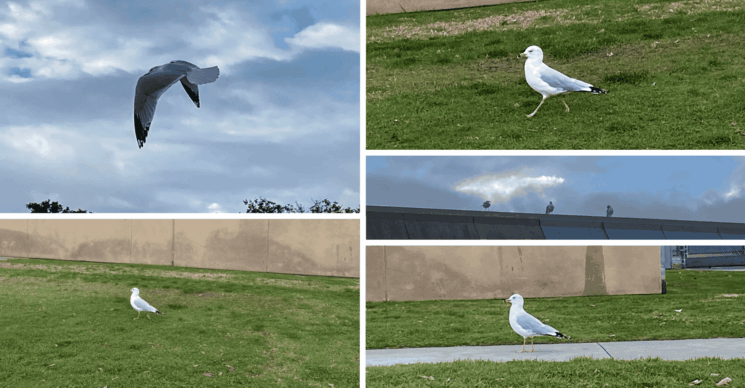
They vortex above the Fountain Valley High School (FVHS) grounds, preying amongst the students and their belongings. These winged scavengers pollute the campus and cars with their droppings. Not to mention, they travel in gangs with hundreds of these voracious creatures, flocking every time the lunch bell rings. Who are these creatures? Since the beginning of time, schools and seagulls have had an infamous yet odd dynamic. These seagulls cause fear in students’ daily lives, but only due to students’ own faults.
Evidently, students retreat to classrooms, shielding their heads with books and jackets from seagull droppings. There is no doubt that the frenzy of seagulls has become a daily struggle for FVHS students.
“The birds are raiding our school. They are not scared of us, we are scared of them. This feels like a situation from the movie ‘Antz’,” freshman Matea Tran said. “They had pooped on my arm, and it was disgusting … they need to find a place to poop besides on people. They’re everywhere, I see them perched up on the gym, and they’re spying on us or something. There’s something wrong with these birds, and I see them circling around the bowl and eating the scraps.”
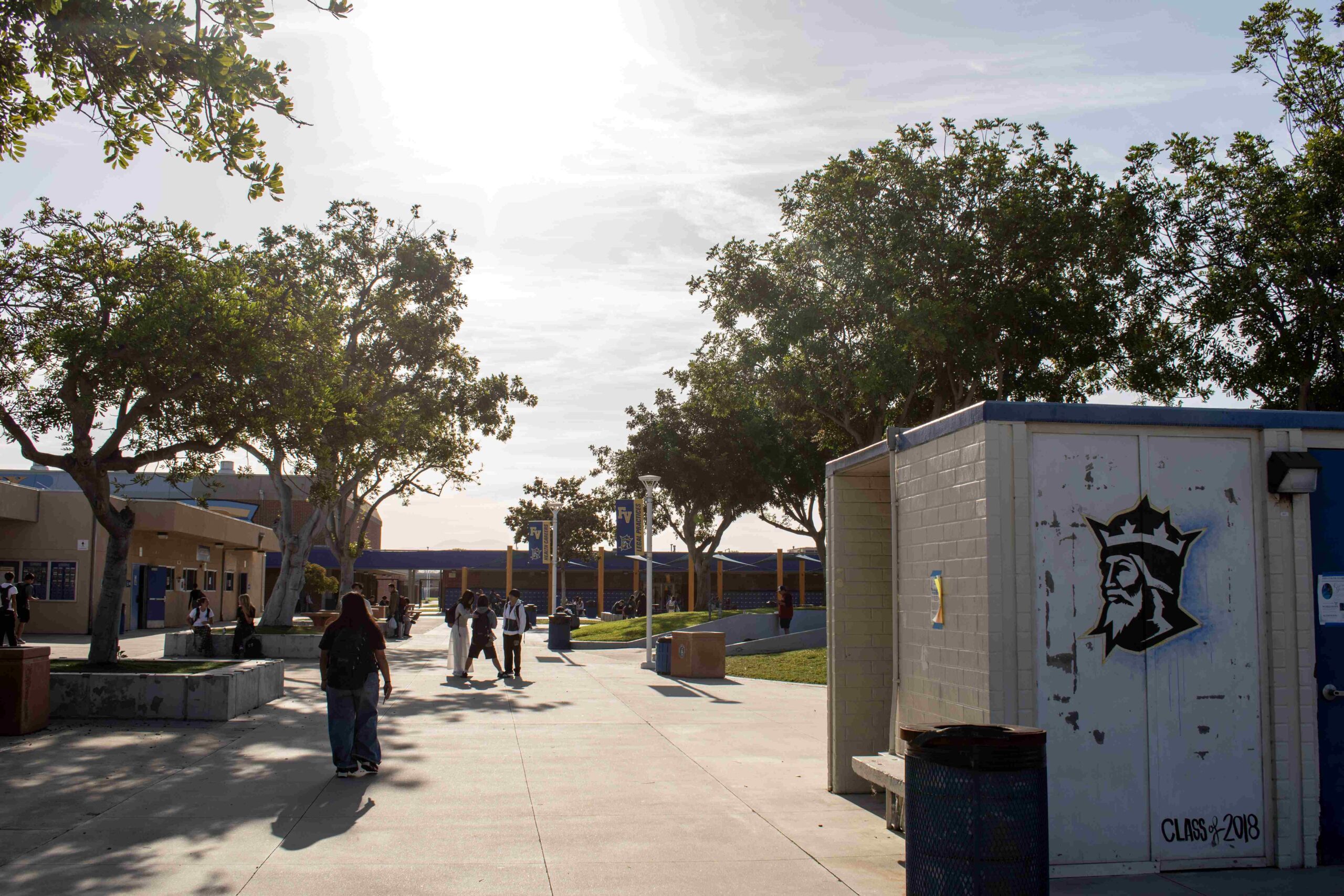
In the bowl, kids face issues with these aggressive birds swarming near eating zones.
“Their behavior is very erratic and a disturbance, to be honest,” freshman Mila Doan said. “Because I feel like they cause a lot of fear in students, and I think they’re probably attracted by a lot of the trash lying on the ground. I think they need to be controlled and [seagulls are] really annoying. I got pooped on once in the bowl. They are usually here [the bowl] and fly very low.”
However, seagulls do not intend to harm students; it is simply in their nature. The great number of seagulls stems from their practice of congregating in social flocks for safety in numbers while foraging and roosting. As beaches become less popular during the wintertime, seagulls turn to inland urban areas for sustenance. Not to mention, these birds are omnivores who not only feed on ocean materials, but almost anything humans dispose of. This explains why they perch above school grounds in search of their next meal. Moreover, seagulls do not poop a lot on purpose, but they dispose of their waste almost every four to 10 minutes due to their fast metabolism and their need to stay light for flight.
Studies show how seagulls’ flexibility in behavior helps them adapt to foraging efficiently in urban areas. According to “Urban gulls adapt foraging schedule to human-activity patterns” published by the National Library of Medicine, they explain, “We aimed to assess the extent to which urban gulls have adapted their foraging schedule to anthropoegnic food source fulctuations related to human activity by combining field observations at three distinct urban feeding grounds (park, school, and waste centre) with global positioning system (GPS) tracking data of gulls . . . We found that the birds’ foraging patterns closely matched the timing of school breaks and the opening and closing times of the waste centre.”
The influx of these birds derive from messy eaters continuously not picking up after their food waste. As a result, students are unknowingly, actively inviting and giving the gulls the motive to linger around the FVHS campus.
“Personally, for me, a lot of them [seagulls] have dropped [poop] on me. Like, a lot of them,” junior Matthew Lai said. “So, the seagulls only exist because we don’t pick up our trash right? Yeah. So, we are gonna pick up our trash and work harder on that.”
Casey Harelson, Assistant Principal of Guidance, hopes that students will clean up after themselves to reduce this issue.
“Well, the seagulls are always going to go wherever there’s food left out. So I do think if students are concerned about it, one thing students can do is be very good about putting their food and garbage in the trash cans,” Harelson said.
It is clear the overall consensus around campus is that in order to free the campus from the poop we need to be more intentional with our scraps. This issue has a simple fix in theory but takes students to work together to act on our commitment for a cleaner campus.