
By Kevin Tran
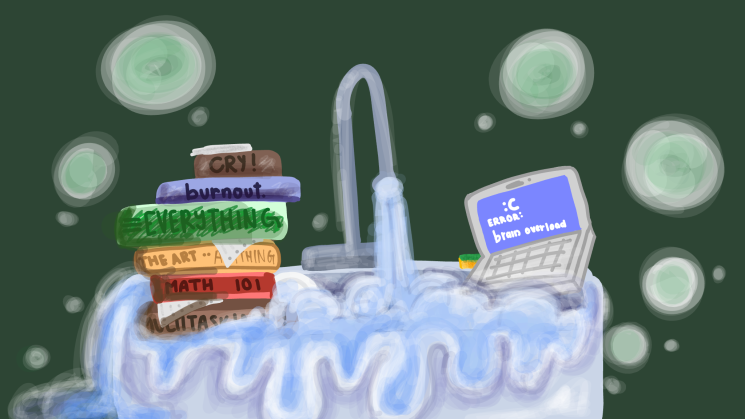
Imagine texting a friend while doing homework and listening to music. While this seems harmless, it actually splits up your focus and lowers overall productivity. This is one of the potential disadvantages of multitasking that you might not have considered.
Multitasking has become a major trend in today’s society. People often text while doing schoolwork or watch TV while eating dinner, believing it makes them productive. However, multiple studies show that multitasking reduces effectiveness and focus and restricts information retention.
One common myth about multitasking is that people believe you can process multiple things simultaneously and effectively. However, scientific findings make it clear that cognitive processes do not function that way. Instead, we task switch by shifting our attention back and forth between activities.
Each time you shift, your brain takes time to refocus. This makes the switch not seamless and leads to reduced efficiency and increased errors.
“We don’t multitask. We task switch. The word multitasking implies that you can do two or more things at once, but in reality, our brains only allow us to do one thing at a time and we have to switch back and forth,” Sofie Bates wrote in a Stanford Report article.
This argument contradicts the belief that multitasking makes things more efficient. The truth is that our minds quickly shift their focus on tasks, creating a false notion of productivity. However, such habits eventually interfere with mental processes.
Alongside its negative impacts on productivity and memory, causing greater cognitive fatigue. The constant switching of tasks forces the mind to repeatedly realign and adjust, using significantly more mental resources.
“People who frequently use many types of media at once, or heavy media multitaskers, performed significantly worse on simple memory tasks,” Stanford psychology professor Anthony Wagner said in the same article.
This indicates that task-switching negatively affects memory retention, requiring the brain to work harder to recall information, which contributes to mental fatigue.
However, some may argue that multitasking is an important skill, especially in fast-paced environments where efficiency is crucial. Certain tasks, like listening to music while exercising or responding to emails while eating lunch, may not require the same level of cognitive effort and can be performed simultaneously without significant drawbacks.
While some activities, such as listening to music while exercising, may not require significant effort, research suggests that multitasking often reduces overall efficiency rather than enhancing it.
“Your current memory recall is abandoned, and you start the entire process anew with the new task,” Jeff Comer said in a Psychology Today article.
In other words, instead of aiding in juggling more than one task, the brain resets its concentration from top to bottom, forcing it to start over each time attention shifts. This constant disruption “causes cognitive confusion and distraction, leading to errors and slower processing times.”
As a result, even simple multitasking can decrease efficiency by making the brain work harder to reorient itself, ultimately slowing progress rather than improving it. This supports the idea that switching between tasks slows down performance, which theorizes that multitasking harms efficiency instead of improving it, even if it’s simple tasks.
Breaking the habit of multitasking is not about accomplishing less. It is about giving one task your full attention so you can understand more, remember more and perform better.