By Hannah Lazarte
What is art, and what isn’t? Is the painting gifted by your friend considered art? Is a banana taped onto a canvas considered art? Is the poster made by a machine considered art? Should the promotion of art be art itself?
While many debate the topic of what makes an artwork, one thing that many people correlate with it is the creativity used. Some may say that creativity lies in the idea, and if that’s the case, giving a prompt to artificial intelligence (AI) to create a poster makes the poster itself an artwork.
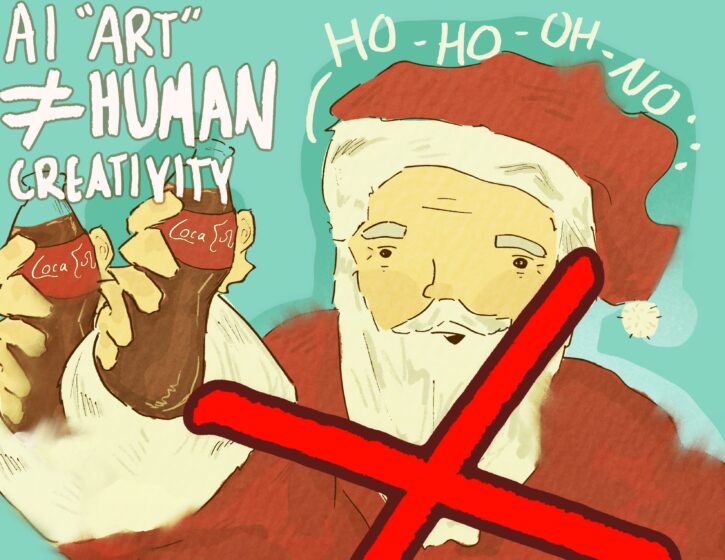
AI advertising has gotten significantly more popular this year, and with it, the creativity in marketing has seemingly diminished over time.
What happened to the fun and creative way of advertising? Why are so many brands now praised for posting a photo of them holding a cardboard sign that says something along the lines of, “We heard you don’t like AI, so buy from us because this sign isn’t AI.”
It’s not only the fact that the product is advertised without human creativity, but there’s another issue of many people being unable to see how a product truly works or looks.
It’s no surprise that many brands have started using AI to make their products seem more appealing. Whether it would be by slightly altering how it looks to making the entire product marketing AI, editing the product in these ways deceives customers.
One example would be how clothing is now “modeled” on an AI person, causing the customer to not see how the piece looks on a real person. Another time this was seen was through Tilly Norwood, an AI actress, who is soon to star in a new movie, Misaligned.
Both of these examples fail at getting the customers’ attention and at promoting art when the “art” is made by a machine. Why would a customer want to buy an art piece if the promotion wasn’t made in the same way?
One thing, however, is for certain, humans have always needed creativity, and with it, art. Marketing was just one way for people to show it. Whether shown through the famous advertisement that showed a boy spending money on Pepsi to be tall enough to reach the Coca-Cola button, or the paper taped on a store window made with a pencil and some markers, art in marketing is necessary.
Human creativity has always been something that has existed in humans for hundreds of years, and we shouldn’t stop now just because it’s “easier.” We lose that ability to create the more we use AI to make our art.
In the end, the real question is, do we value creativity more than efficiency when it comes to both art and its promotion?