By Kevin Sears
It’s easy to view our teachers as taskmasters, pushing us to tediously analyze endless novels — dissecting complex themes, broad motifs and intricate irony. But beyond the grueling lesson plans and curricula, have you ever wondered what they read for fun? A teacher’s favorite book and reading habits can reveal far more about them than the work they assign.
I spoke with two teachers to uncover their go-to reads, exploring the literary works that resonate most with them and shaping their perspectives and passions inside and outside the classroom.
Hoa Kim
Math teacher Hoa Kim often finds herself balancing between her leisure love for reading and her work teaching.
“I do consider myself a reader. I try to read as much as I can during breaks because, during the school year, I’ll eventually just get lost in a book and then not do the things I’m supposed to do, like grade,” Kim said. “For example, right now, I’m stuck in the middle of a book I didn’t finish over the summer, and it bugs me. But then I remind myself I need to set it aside and revisit it later. So yes, I am a reader, and I make it a point to read.”
During the school year; however, Kim mostly reads things that are more news-oriented instead of books.
“I have news apps [like] USA Today and CNN. That’s all I have time for. You know, when you’re busy, it’s just small snippets of articles, [rather than] having [the] time to delve into a book,” Kim said.
The most recent book she has read is “Us Against You: A Novel (Beartown)” by Fredrik Backman.
“It’s written in a very unique way. I’m [not sure] how to describe the pros of it, but it’s just interesting,” Kim said. “If you read the first page, you can tell that the writer writes differently.”
Kim finds her books through recommendations from friends and acquaintances.
“I’m open to all sorts [of genres], just probably not mystery or horror. I like historical fiction [and] biographies [that explore] the sides of history that you don’t usually see in a history book,” Kim said. “For example, if they delve into something that I had no idea happened when we [took] history. I think that’s the most interesting to me, because after I finish the book, I dig into and search [for] articles about [that] side of history that you don’t see.”
One book about history that Kim highlighted as particularly enjoyable is “The Immortal Life of Henrietta Lacks” by Rebecca Skloot.
“You have to read it because it’s not written from her perspective — she’s passed already. The lady had cancer at a really prestigious university [where] they removed her cells without her permission. They use [her cells] for research.” Kim said. “To read about what happened to her family while this was concurrently happening is just really interesting.”
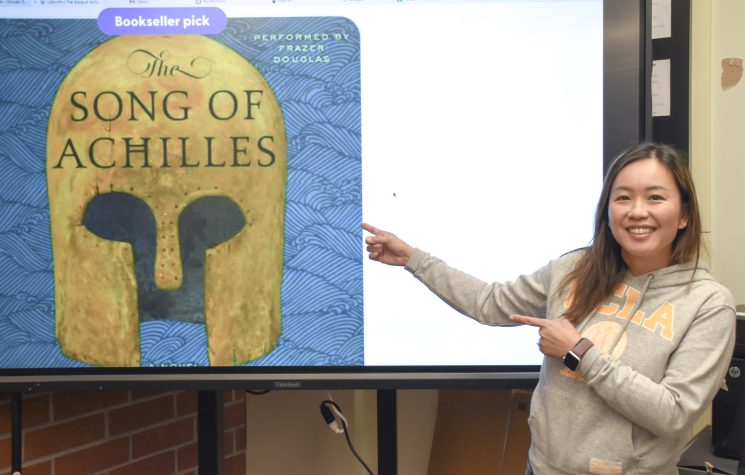
Kim reads more fiction than nonfiction. Her favorite book is the novel called “The Song of Achilles” by Madeline Miller.
“I was always into Greek mythology, and this is a spin-off of it. The story is just beautifully written. I actually even saved a quote from it in my notes. It just stuck with me, like the first line was enough to get me hooked,” Kim said.
“We were like gods at the dawn of the world, and our joy was so bright we could see nothing else but the other.” (Miller, 103)
“There’s some controversy [about] the nature of their relationship. But I think, just, if you look beyond that, it’s just written so well — it reads like a poem,” Kim said.
Doug Wilton
Doug Wilton, an English teacher with a passion for reading, finds his time limited during the school year.
“I don’t [read] as much fiction as I want to these days, because life seems to be really busy,” Wilton said. “In the summer, I read a lot more novels and fiction, but during the school year, it’s mostly nonfiction; I pore through the [TV] news and read the news almost daily.”
Wilton just finished the book “Rich Dad, Poor Dad” by Robert Kiyosaki and Sharon Lechter and was motivated to pick the book up by his desire to learn more about financial things.
“I wouldn’t say [the book] is super practical; it’s more philosophical. The author seemed to be talking about a period in the 70s, [when] I think the economic climate was drastically different than it is today,” Wilton said. “So I’m trying to find some little, you know, nuggets I can use in there, but I’m not sure I would recommend it to someone else.”
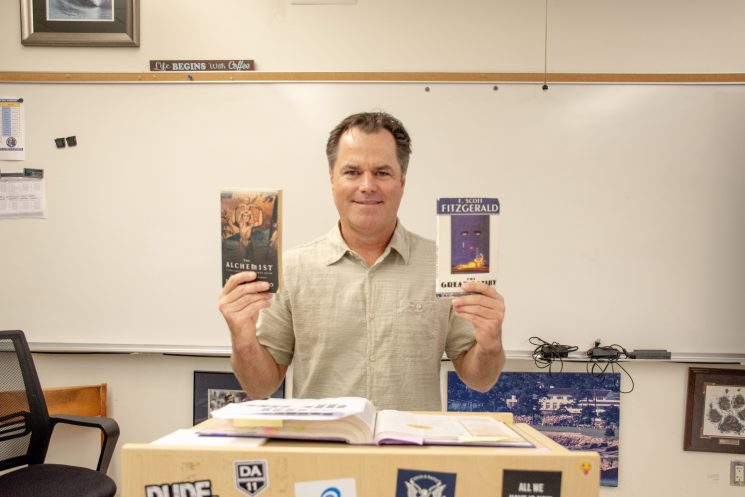
Wilton has two favorite books, the first of which is “The Great Gatsby” by F. Scott Fitzgerald, which he taught to juniors.
“Fitzgerald’s ‘The Great Gatsby” [is] regarded by many as being the perfect, perfect novel,” Wilton said. “The description and writing are almost flawless. I would suggest anyone who hasn’t read it to read it and appreciate it. I’ve probably read it about 12 to 15 times, and each time, I find something just more beautiful about it.”
Wilton has a favorite line from the book.
“He had one of those rare smiles with a quality of eternal reassurance in it, that you may come across four or five times in life. It faced, or seemed to face, the whole external world for an instant and then concentrated on you with an irresistible prejudice in your favor. It understood you just as far as you wanted to be understood, believed in you as you would like to believe in yourself.” (Fitzgerald, 48)
“And, you know, ‘Gatsby’ has all kinds of nuggets like that that are just beautiful, flawless writing, in my opinion,” Wilton said.
Wilton’s other favorite book is one he teaches to freshmen, “The Alchemist” by Paulo Coelho.
“I just like the message in it. There are a lot of little tidbits that remind you that life is about the journey. Too often we’re trying to get to this destination: to graduate high school, to get into college, to get that good job and [to] settle down in a meaningful relationship. [We’re] trying to get to these destinations where we don’t really enjoy the journey along the way and we’re not really present,” Wilton said. “So this book reminds you to be present and learn from daily interactions, like the [interview] we’re having right now.”
Wilton would recommend “The Alchemist” to anyone as a coming-of-age story that can apply to everyone’s life.
Final thoughts
The books that teachers read outside the classroom offer a window into their personalities and life. While we often see them as figures of authority, pushing upon us assignments and curricula, their own reading habits remind us that they, too, are avid readers with unique tastes and interests. Whether it’s a cherished novel that sparks nostalgia or a historical story that fuels their curiosity.
So, the next time you’re handed an assignment, consider this: the books your teacher chooses to read in their free time might just be as insightful as the ones they assign to you.