
By Arielle Nguyen
It starts like any other day: a quiet classroom, a government assignment and the slow, creeping realization that you probably should’ve paid more attention during the lesson on checks and balances.
Then the door swings open.
Your old economics teacher walks in, along with, you think, everyone and your mother. An entire entourage of students and staff like she’s about to announce the winner of a reality TV show. And she does. Except instead of someone else, it’s you.
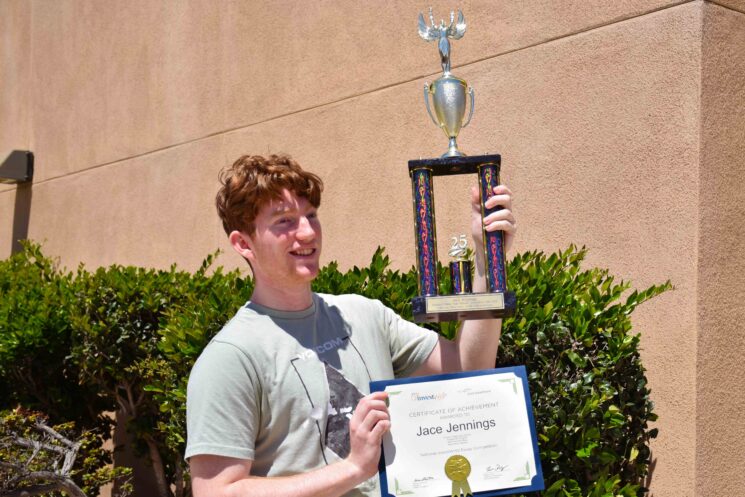
Senior Jace Jennings lived through exactly that, though he likely paid attention to his lectures.
“I was focused on my government assignment,” Jennings said. “And then Mrs. McCance, along with [members of Supervision] and her class just walked into [my] classroom and announced someone had won [the InvestWrite Competition] … I was just … thinking, ‘good for them’ and I kept working.”
The InvestWrite Competition, an essay contest tied to the Stock Market Game, isn’t exactly the most casual of documents you throw together at 11:59 p.m. Students are handed $100,000 in hypothetical cash and tasked to invest it in actual companies. After about a month and a half of tracking their portfolios, analyzing trends and staring at graphs until their eyes blurred, they write an essay reflecting on what worked, what didn’t and what they’d do differently. It’s capitalism, but with a grade attached.
“[Sarah McCance] actually submitted [all the essays] … I didn’t physically submit my work to the competition,” Jennings said.
Which makes the win feel like accidentally entering a raffle and walking away with the grand prize: a medal, certificate, a trophy almost as tall as Jennings and $100.
Not bad for an assignment Jennings forgot existed. To be fair, with the entire state of California competing, expectations were decidedly low.
“Since [my class and I were] going up against everyone else in [California], the chances of winning aren’t great … I wasn’t expecting too much,” Jennings said.
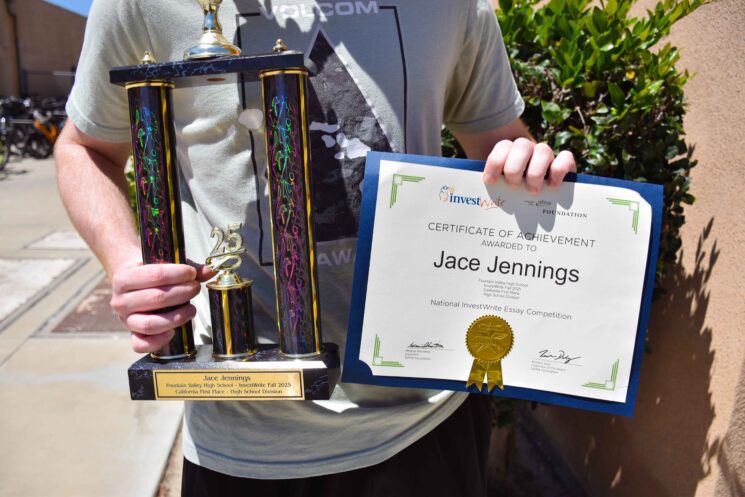
For Jennings, who hasn’t won awards like this before, the recognition hits harder, especially considering the amount of effort behind the scenes. Part of the process involved closely monitoring investments: analyzing the stability of stocks, the volatility of some and the performance of trends long-term.
“This essay was definitely a longer essay than normal,” Jennings said. “I had to sit down and think about what I was going to write for this … it took about a week to write.”
Luckily, Jennings didn’t go in completely blind. With advice from both his teacher and parents, he had a solid foundation.
“I’ve gotten bits and pieces of information from my parents, mainly my mom, because she … had to focus on investments for a job,” Jennings said. “She really honed the idea that you want to focus on diversity with your stocks, [which means] to separate your investments into things that are volatile, [and things] that are safer.
In other words: “Don’t put all your eggs in one basket, because if the market crashes, you lose everything.”
When it came to actually crafting the essay, Jennings leaned on familiarity.
“Stick to what you know … practice is good for learning any sort of skill, so in this case, especially when writing [an essay] about something I didn’t know too well, I just had to stick to what I’ve known in previous subjects, like English.”
Looking ahead, Jennings is considering a future in IT, a path his father had chosen for himself as well. While it may not be directly tied to essays, the field still benefits from strong communication skills.
Although the stock market experience started as just another, albeit lengthier, assignment, it ended with a statewide win and cash to celebrate. If nothing else, proof that doing your homework might actually pay off.