
By Talan Quinteros and Kevin Tran
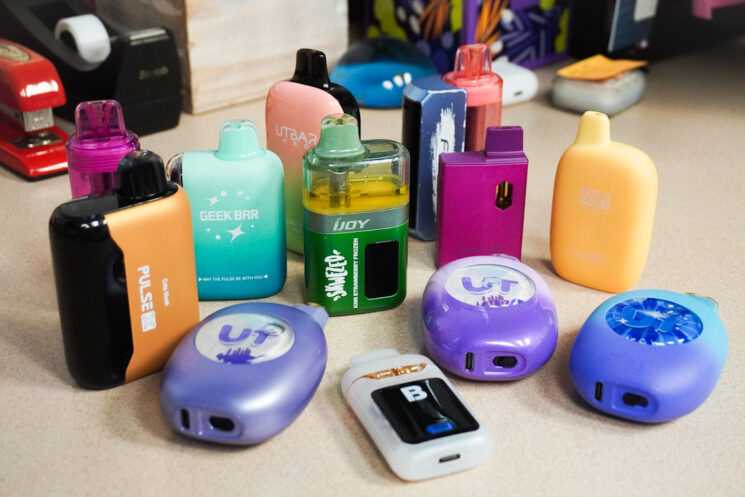
Millions of America’s high school students, on a daily basis, are falling under the addictive trance of e-cigarettes. Vaping, marketed as a safer alternative to smoking, has evolved into a widespread issue across the US and is starting to affect those at Fountain Valley High School (FVHS).
According to the Centers for Disease Control and Prevention, approximately 1.63 million middle and high school students reported current e-cigarette use in 2024. Of those, about 1.21 million were high school students, representing 7.8% of that population.
FVHS is starting to fall victim to this epidemic. In the 2025-2026 school year, all of the signs have become apparent in male restrooms across campus. Frequent excessive restroom crowding, the same groups entering and exiting the same stall and consistent gatherings throughout the school day have raised concerns among the student body.
Vaping has become similar to a plague, spreading from one student to another due to the desire to fit in or to be like their friends.
“I know it’s out there. I know kids looks at all sorts of things on social media… but also their friends, right? A lot of their friends, friends’ friends, or friends of a friend of a friend are doing it so [students] just want to try it… But a lot of the time, kids just do it just to be cool,” assistant principal of supervision, Hayato Yuuki says.
From early mornings, before first period at 8 am, lunch and passing periods, almost every restroom seems to be consistently occupied by the same groups of students.
These observations do not represent every student; they point to a clear shift in how some spaces are now being utilized. It is also reflecting the image of the FVHS student body as a whole. What was once a regular stop before class for natural human needs has become a common group for vaping.
“If there’s a smell in the air or you see it all foggy or cloudy in the bathroom, then supervision is going to pull everybody up that’s in there, it doesn’t matter. We talk to the individual kids, and we actually search them. We search them and then search their belongings just to see. But it is hard, we are not going to catch everybody… and the bathroom is just one place… and [students] are deceitful in where they hide it,” says Yuuki.
Beyond the poor behavior itself, the issue raises bigger concerns about the health and well-being of these students. E-cigarettes often contain nicotine, a highly addictive substance that can affect brain development in adolescents.
Recent research published by U.S. Right to Know found that vaping can expose people to dangerous levels of toxic metals. According to the article, “even short-term exposure produces a measurable buildup of toxic metals in lung tissue,” increasing the risk of serious health issues such as cancer and cardiovascular disease.
“Every time [supervision] catches somebody for the first time, whether it’s a nicotine vape or marijuana vape, we have a program that we work with called Yvape. It’s a nicotine program that the kids and the parents go through together. Similarly, if a kid gets busted with a marijuana vape… we do enroll them in a Jade New Beginning Program. That’s a little bit more in-depth, more intense, only because you’re dealing with drugs now. Nicotine’s a drug[,] but marijuana is obviously a more classified drug,” says Yuuki.
However, there are ways for students to make their own impact on the campus. FVHS offers multiple anonymous and non-anonymous methods for students to report incidents such as vaping and smoking.
“If [students] feel comfortable[,] they can come up and report it. I know nobody wants to be a ‘snitch’ so you know a lot of times they don’t. We do have our everyday text-to-tip, which is in on the 5-Star digital ID [app]. If they scroll the menu bar to hotlines, you can find the text to the tip number on there. But also, we have Titan HST, where kids can report drugs or smoking on campus and it’s all anonymous,” Yuuki notes.