By Kevin Tran
Cell phones are, without a doubt, one of the biggest obstacles when it comes to learning in schools today. From constant text messages to social media notifications, many students often lose focus because of a simple buzz on their phone.
In response to this distraction, many schools have started to have restrictions on phone usage, hoping to improve learning and student behavior, and this has been growing constantly across schools. For example, schools in Orange County, such as Trabuco Hills High School, Cypress High School, and Irvine High School, have rules that limit when students can use their phones during the school day.
According to Education Week, “At least 31 states and the District of Columbia require school districts to ban or restrict cellphones.” The article also states that “22 have a so-called bell-to-bell ban,” meaning students cannot use their phones for the entire school day.
Phone bans have moved on from being a basic rule and are now a major education policy across America. Since so many states have these restrictions, are these phone bans actually benefiting the students?
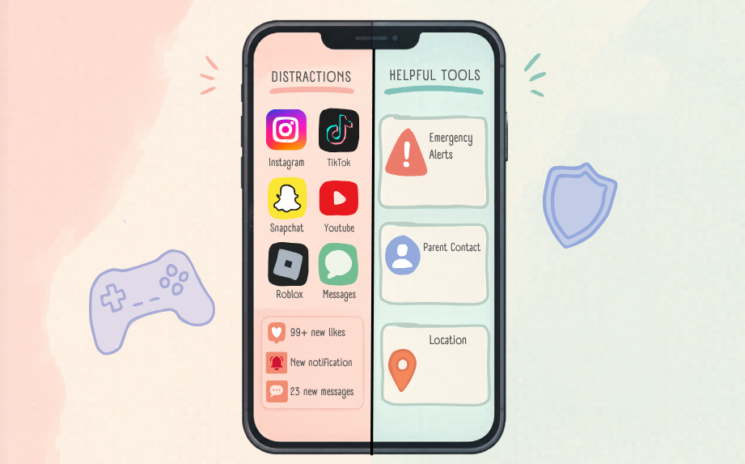
Although the removal of phones in classrooms may help students stay more focused with fewer distractions in the way, they do not fully benefit students because it limits the freedom of what students can do. For example, completely abolishing phone usage in schools won’t help students learn how to manage their time, and it can also be a big problem when emergencies arise.
During emergencies, phones are one of the easiest ways for a student to contact their parents. Although all schools have implemented emergency systems, communication may be delayed during chaotic situations, so the student may not be able to contact their parents right away. If students are completely separated from their phones, they may feel less comfortable, and parents may not be able to contact their kids directly when an emergency happens.
An article on K-12 Dive explains that, “78% of parents polled want their children to have cellphone access during the school day in case there’s an emergency.”
This demonstrates that many parents do not see phones only as distractions. They also see them as a way to stay connected with their children during serious situations.
Beyond just safety, in a Harvard Graduate School of Education EdCast, a researcher named Vicky Goodyear explained, “We collected data from over 1,200 adolescents across 30 different schools, and what the study found was that there was no difference in outcomes for pupils who attend a school with a phone ban compared to those that don’t.”
This research shows that cell phone bans have not made a significant difference when it comes to academics. Although phone usage was reduced to “40 minutes on phones and 30 minutes on social media,” the effects were limited and only lasted during school.
Furthermore, students still spent a large amount of time on their phones outside of school. Goodyear explains in the same EdCast that students in the study spent “four to six hours” on their phones each day and “two to four” hours on social media.
Banning phones during school may get rid of distractions for a couple of hours, but it does not solve the bigger problem if students continue using their phones heavily after school. Some students spend hours doomscrolling, texting, or watching videos at home, it can still affect their sleep, homework, attention span and academic performance.
Ironically, phones, in a way, help students learn time management when they are allowed to practice controlling their phone use instead of having it completely removed.
If schools just completely remove phones, students aren’t really learning how to manage distractions on their own outside of school; they are only avoiding distractions because it’s been taken away.
However, when students are given limited phone access with clear rules, they have to learn when it is appropriate to use their phone and when they need to put it away. This can help students be more responsible and build self-control, helping also manage their time with phones outside of school hours.
Overall, phone bans may help reduce distractions in the classroom, but they are not a complete solution to the problem. Sure, students may focus better when phones are taken away in the classroom, but bans cannot help how much time students spend on their phones outside of school.
Phone bans may help in the short term, but long-term success depends on whether students learn how to manage their own phone use.